
Beyond the Title: 12 Questions with Johnathan Delgado

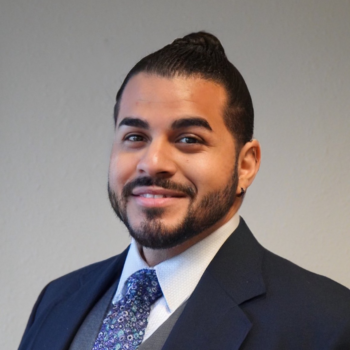
Johnathan Delgado
Community Advocate and Strategist, Delgado Campaign Solutions
Johnathan Delgado is founder and owner of Delgado Campaign Solutions, a small business dedicated to uplifting communities through meaningful relationships and culturally centered initiatives through small business development. He is also founder of the Puerto Rican Awareness Project, a coalition and organization devoted to recognizing and acknowledging the Puerto Rican Diaspora in Wisconsin. Johnathan chaired the Community Initiative Action Council with the United Way of Dane County, was appointed by the Mayor to serve on the City of Madison Public Safety Review Committee, and has led multiple successful campaigns for local government. Recently, Johnathan has returned to complete his undergraduate degree in Psychotherapy and Social Work.
01Built to Last starts with a strong foundation. What is the foundation your leadership is built on, and how do you return to it when things get shaky?
My leadership is built on people, relationships, and service. I've never really separated leadership from community. For me, leadership is about asking, “Who is being impacted by this decision, who isn't at the table, and what responsibility do I have to make space for them?”
When things get shaky, I try to return to purpose. Titles change. Organizations change. Opportunities come and go. But the reason I started doing this work in the first place hasn't really changed. I want people, especially people who have historically been overlooked or underestimated, to know that they belong in the room and have something worth contributing.
02Where do you come from, and how do your roots keep you steady when leadership gets hard?
I am Afro-Boricua, Afro-Puerto Rican, born and raised in Chicago in a community known as Paseo Boricua, or Puerto Rican Pass. I come from people who were lifelong volunteers and activists, folks who may not have gone beyond a high school education but who understood the value of showing up for their families, their neighbors, and their community.
I came of age in Madison, WI, and much of who I am exists between those places and those experiences.
My roots remind me that I come from people who have always had to create community, opportunity, and belonging, sometimes in places that weren't necessarily designed with us in mind. That keeps me grounded. It reminds me that leadership isn't about being the most powerful person in the room. Sometimes it's simply about remembering who you are, where you came from, and who you're accountable to.
03What's a piece of advice that has stood the test of time for you, the kind you still come back to years later?
Relationships matter more than someone's title.
Positions are temporary. Organizations change. You might be the chair, director, founder, employee, or volunteer today and something completely different tomorrow. But the way you treated people tends to follow you.
Some of the opportunities I've had in my life didn't come because of a title I held. They came because somebody remembered how I showed up, how I treated people, or how I contributed when there was nothing immediately in it for me.
04What's a book, quote, lyric, or scripture that has stayed with you and shaped how you lead or live?
One quote that has stayed with me is, “Few are those who see with their own eyes and feel with their own hearts,” often attributed to Albert Einstein.
What I take from that is the importance of thinking for yourself while still remaining deeply connected to other people. Leadership can come with a lot of pressure to follow what has always been done, to accept someone else's interpretation of a situation, or to make decisions based solely on what looks good on paper.
I try to see things for myself: to pay attention, ask questions, and understand what is actually happening. But I also try to lead with heart and remember that there are real people behind every decision.
05What's something you've had to rebuild after it broke or fell apart, and what did that teach you about building things that last?
I've had to rebuild professionally and personally more than once. And I think one of the things rebuilding teaches you is the difference between your identity and your position.
There are moments when something you worked hard for ends, an organization changes, a relationship changes, or the plan simply doesn't work anymore. Those moments force you to ask, “What actually belongs to me?”
Your title may disappear, but your experience doesn't. Your relationships don't. Your skills don't. Your values don't.
I've learned that if you build your identity entirely around a position, losing that position can feel like losing yourself. But when you build around purpose, you can carry that purpose into whatever comes next.
06What's one question every leader should ask if they want to build something that outlasts them, and why?
“Who needs to be here that isn't here?”
Because sometimes the weakness in a foundation isn't what's already there. It's who is missing from it. Who has experience, perspective, relationships, or knowledge that we haven't included yet?
If we want to build something that lasts, we have to think about both the strength of the structure and the people who are helping shape it.
07Who are you actively preparing to carry this work forward, and what are you doing to set them up to succeed without you?
I think about my children first. Not necessarily because I expect them to carry the same organizations or do the same kind of work I do. I don't want to predetermine what their purpose should be.
What I want to pass along is the belief that they have agency, that they can create things, challenge systems, serve their community, and belong in rooms where decisions are being made.
Beyond my family, I try to create that same mindset in younger leaders and people entering community spaces. Sometimes preparing somebody doesn't mean giving them your position. Sometimes it means giving them information, introducing them to someone, encouraging their idea, or simply telling them, “You can do this too.”
08When leadership feels heavy, what do you turn to (music, travel, culture, faith) that restores you and keeps you feeling like yourself?
When leadership feels heavy, I turn to fun. Being with family and friends brings me back to myself.
I love dancing salsa, cookouts with the family, good food, music, laughing, and just being around people I care about.
Those moments remind me that not everything is as serious as it may seem in the moment. Leadership can get heavy, and sometimes the best thing we can do is step away from all of that responsibility for a while and remember how to just enjoy life.
That helps me come back feeling more grounded, more like myself, and usually with a little more perspective.
09When you think about the legacy you want to leave, what do you hope still stands long after you've moved on?
I hope people feel like they had permission to build something of their own.
I don't think legacy has to mean having your name attached to something forever. For me, it is more about whether the people around you felt seen, supported, encouraged, and capable of doing more because you were there.
If somebody I helped, mentored, encouraged, or simply made room for goes on to create something meaningful for somebody else, that matters to me. I want the impact to keep moving, even when my name is no longer attached to it.
10What's a small daily habit or discipline that has compounded into something meaningful over time?
Showing up.
That can mean answering the phone, sending the text, going to the event, checking on somebody, following through, or being present when it would be easier not to be.
I come from people who taught me that showing up matters. Over time, those small moments build trust, relationships, and community.
I think a lot of meaningful things in my life have come from consistently being present, not necessarily from having the perfect plan.
11What's a moment in your life where the music playing in the background ended up meaning more than you expected, a song that showed up right when you needed it, or made an ordinary moment stick with you?
When Bad Bunny released Debí Tirar Más Fotos around Three Kings Day in January 2025, I was struggling to find the motivation to finish the last semester of my associate degree.
That album hit me at exactly the right time. It brought me back to Puerto Rico, to my culture, and to the struggles and sacrifices of the people who came before me. It made me think about how many of my ancestors never had access to the opportunities that I have, especially the opportunity to pursue higher education.
In that moment, finishing my degree stopped feeling like something I was just trying to get through. It reminded me of my purpose and of everything I hoped to build with that education.
The album helped me remember that what I was working toward was bigger than a semester, a class, or even a degree. In a way, I wasn't only doing it for myself. I was carrying something forward.
12What's a tradition in your life or family that you hope lasts for generations?
I hope my children and the generations after them continue our family ofrenda.
Our ofrenda is really a centerpiece of our home. It's where we honor our ancestors, remember the people who came before us, and keep their stories and presence alive. There are old photos, memories, and pieces of our family history there, but to me it represents something bigger.
It is a reminder that family doesn't end when someone is no longer here physically.
My hope is that one day my children will add their own pieces to it, tell the stories behind the people whose pictures are there, and eventually pass that responsibility on to their children.
I love the idea that, generation after generation, there will always be a place in our home where we can all be together, even when some of us are no longer here in the physical.